


The Integral Safety Concept from Mercedes-Benz divides vehicle safety into four phases:
Virtually no other area inspires the Mercedes-Benz engineers to produce such consistently impressive results as much as research into new safety technologies. The first important safety milestone was reached back in the 1950s with the development of the passenger safety cell, invented by Béla Barényi. Today it is just one of many components of the Integral Safety Concept which edges Mercedes-Benz vehicles ever closer to our vision of accident-free driving.
Equipment availability depends on the engine and configuration selected. You will find details in the equipment information for each model.
More detailed information:
Phase 1: safe driving
The majority of accidents start long before the actual collision: with a lapse in concentration, poor visibility or hazards which cannot be anticipated. That's why the Mercedes-Benz safety concept employs a range of measures to support safe driving in everyday operation and to help you bring critical situations under control.
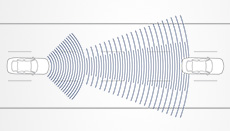
DISTRONIC PLUS proximity control helps the driver to maintain a specified (timed) distance from the vehicle ahead when travelling at speeds of 0 to 200 km/h. Implementing BAS PLUS Brake Assist in conjunction with the PRE-SAFE® brake system helps to avoid rear-end collisions more effectively. If radar sensors identify a potential collision and the driver applies the brakes, BAS PLUS is primed to apply a brake force commensurate to the situation and available stopping distance.
| |
When the high beams are activated, Adaptive Highbeam Assist always provides the optimum headlamp range and prevents dazzling oncoming traffic. The driver hardly has to operate the high-beam switch any longer and is able to better focus on the driving tasks.
| |
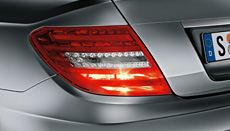
In critical braking situations, specific criteria such as brake pressure and speed are used to activate the adaptive brake lights if necessary. When activated, the brake lights flash to give drivers behind even better warning of the risk of a rear-end collision. The flashing brake lights can help in an emergency situation to significantly shorten the reaction time of road users following behind. The LED adaptive brake lights thus make an important contribution to preventing rear-end collisions. Studies have shown that drivers' brake-activation response times are shortened by up to 0.2 seconds when emergency braking is indicated by a flashing red warning signal instead of conventional brake lights. At a speed of 80 km/h, this reduction in response time corresponds to a reduction in stopping distance of approximately 4.40 metres. The brake lights flash with a frequency of approx. 3 Hertz (with incandescent bulbs) or approx. 5 Hertz (with LEDs); tests have shown this frequency range to be particularly effective.
| |
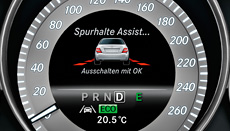
Inattention and fatigue can result in you drifting out of your lane without realising it. With the aid of a stereo camera, the system can detect when continuous or interrupted lane marking are crossed unintentionally. In that case the driver is immediately warned by means of a pulsed vibration of the steering wheel. If the driver does not react to the warning, Active Lane Lane-Keeping Assist can help to return the vehicle to the correct lane by selectively braking individual wheels Braking interventions are always performed when the vehicle unintentionally drifts across continuous lane marking lines.
| |
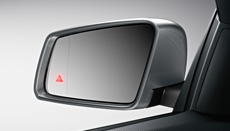
The system makes it possible to tackle one of the biggest dangers in road traffic visible – vehicles in the blind spot. If changing lane, for example, it can warn the driver and apply selective braking to individual wheels to avert a potential collision. The Active Blind Sport Assist radar sensors monitor the hard-to-see sector at the sides and behind the vehicle at speeds between 30 and 250 km/h. As soon as a vehicle is detected in the blind spot area a red triangle lights up in the corresponding exterior mirror.
| |
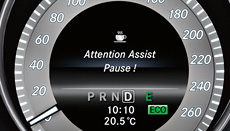
The ATTENTION ASSIST function is particularly helpful on long journeys and when driving at night; the system warns the driver if it detects signs of failing attention and increasing weariness. At speeds of between 80 and 180 km/h, ATTENTION ASSIST warns the driver visually and audibly as soon as it detects any signs of drowsiness or inattention. The background: sensors analyse driving behaviour and can detect any changes compared with the previously determined individual driver profile.
| |
The system can recognise an emergency stop by the driver and increases the brake pressure within fractions of a second to shorten the stopping distance. To do so, Brake Assist interprets the speed at which the brake pedal is depressed. A sensor permanently monitors the speed at which the brake pedal is depressed and transmits this data to the electronic control unit. | |
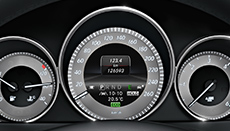
The braking system increases driving comfort and safety. On the one hand it helps to perform critical braking manoeuvres with the basic function of the ABS anti-lock braking system while on the other hand, convenience functions make coping with daily driving situations easier. The functions at a glance:
| |
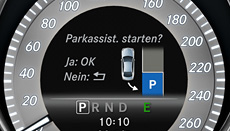
This system helps the driver to search for a parking space as well as parking in a parallel parking space. It provides the driver with steering recommendations in the instrument cluster. PARKTRONIC monitors the front and rear of the vehicle when manoeuvring and warns the driver if a potential collision is detected. Parking Guidance is automatically active at forward speeds of up to 30 km/h. If the vehicle is moving at a speed lower than 30 km/h, the system automatically seeks out and measures parking spaces on either side of the vehicle. The presence of an adequate parking space is indicated by means of a blue "P".
| |
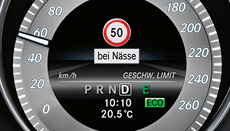
Speed Limit Assist uses an integrated camera to identify the speed limits on road signs and show the permitted maximum speed on the central display. The system also compares identified speed limits against the data stored in the navigation system.
| |
For the best possible visibility on country roads and motorways, on bends and in foggy conditions, the Intelligent Light System with adaptive bi-xenon headlamps automatically adapts to the weather, lighting and driving conditions . On country roads the left-hand side road edge is significantly better illuminated, in particular when the foglamps are switched on, on the motorway the range of visibility is increased by up to 60 percent. The extended fog lamp function prevents dazzling of the vehicle's driver due to light reflected by the fog.
| |
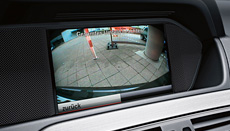
Reverse parking and manoeuvring is considerably easier and safer using the rear-view camera. It is activated automatically when reverse gear is engaged and shows the area behind the vehicle (with dynamic guidance lines) on the central display.
| |
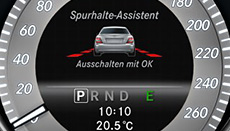
Inattention and fatigue can result in you drifting out of your lane without realising it. The system can recognise inadvertent lane departures and can warn the driver with pulsating steering-wheel vibrations. The system processes the images provided by a camera placed behind the windscreen. Lane markings are registered thanks to differences in contrast. From these data and the actions of the driver that have been registered , the Lane Keeping system determines whether the vehicle is leaving the lane it is travelling in intentionally or not.
| |
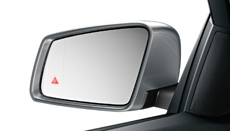
The system visualizes one of the major hazards in traffic. If a vehicle is detected in the blind spot, a red triangle appears in the exterior mirror. Should the driver fail to notice the visual clue and activate the turn indicator, the system issues an additional audible warning. The Blind Spot Assist system is active at speeds between 30 and 250 km/h. Below 30 km/h a yellow triangle indicates that the system is inactive. Blind Spot Assist can be activated and deactivated via the "Assistance systems" menu in the instrument cluster.
|



Phase 2: in critical situations
Mercedes-Benz stands for automotive safety. That's why our vehicles can support their passengers even in critical driving situations, so that every journey is as safe as it can possibly be.
The anticipatory braking assistance system can reduce the risk of rear-end collisions.Radar sensors and a stereo camera are used to permanently record and evaluate the situation ahead of the vehicle. If the driver identifies a potential accident and applies the brakes, BAS PLUS supplies additional braking pressure to ideally prevent a collision. If an impact is unavoidable, a full brake application reduces the impact speed as much as possible. | |
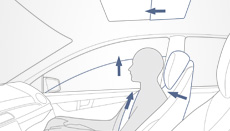
The system is able to identify critical handling situations in advance and initiate preventive measures for occupant protection in the event of an impending accident. These include e.g. the reversible belt tensioning or the automatic closing of any open windows. PRE-SAFE® evaluates sensor data from other systems, such as the Electronic Stability Program ESP® and Brake Assist system BAS, and can identify scenarios such as heavy over/understeer and emergency braking.
|
Phase 3: in an accident
Cars from Mercedes-Benz have a host of safety systems to prevent accidents. Should the worst come to the worst, however, a number of occupant safety measures are activated. They include protection for the vehicle occupants as well as for other road users.
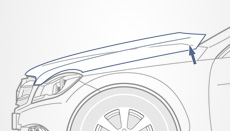
The bonnet is raised up in a frontal collision with a pedestrian or cyclist. The increased distance to the engine compartment assemblies creates additional deformation space, which can reduce the risk of injury to the pedestrian in certain scenarios.
| |
In a collision the airbags help to protect the torso and head of driver and front passenger. They also help to stabilise the whole body. This can mitigate the risk of severe injuries in an accident. The deployment of the airbags is commensurate to the severity of the impact. | |
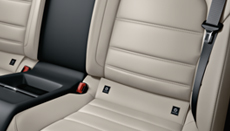
The system allows simple, fast and safe attachment of ISOFIX child seats for optimal protection of the child in an accident. TopTether anchoring points offer added safety by anchoring the child seat on the rear of the rear seat backrests.
| |
The kneebag on the driver’s side helps to protect the legs in a collision and also stabilises the entire body. It can thus help mitigate potentially severe injuries sustained in an accident. | |
In a side-on collision the sidebags help to protect the torso and pelvic area of driver and front passenger. This can mitigate the risk of severe injuries in an accident. The pelvisbag is deployed in the space between the front-seat occupants’ pelvic region and the door panelling. The pelvisbag then braces itself against the impact area, pushing the occupant’s pelvic region away from the door panelling at a very early stage of the collision. | |
In a side-on collision the sidebags help to protect the torso and pelvic area of driver and front passenger. They also help to stabilise the whole body. This can mitigate the risk of severe injuries in an accident. | |
In a side-on collision the window airbag covers the side windows and can help reduce the risk of the head impacting the sides of the vehicle or intruding objects. It protects the driver, front passenger and passengers on the outer rear seats. When deployed, the windowbag covers the side panes between the A- and C-pillars like a curtain. The windowbag covers a large part of the side when deployed.
|
Phase 4: after an accident
To reduce consequential damage after an accident and support the work of the rescue services, a number of different actions are initiated, depending on the type and severity of the impact registered by the system:
- Best possible protection: the engine can be turned off automatically and the fuel supply can be cut off.
- Eye-catching lighting: hazard and emergency interior lights can activate automatically to lower the risk of accidents and help locate the car.
- Automatic ventilation: if an airbag deploys, the power windows are lowered automatically.
- Easy opening: after an accident the doors are unlocked automatically to make it easier for the occupants or rescue workers to open the doors.
- Measures to aid rescue: integral crash joints between the wing and the door can make opening the doors after a frontal collision easier.
- Helpful connection: In the event of an accident or breakdown, the Mercedes-Benz emergency call system (in conjunction with a connected mobile phone) can automatically contact an emergency call centre.
Every second counts when it comes to occupant rescue after an accident. That's why Daimler has devised the rescue sticker, a small but effective innovation that gives emergency services immediate access to safety-relevant vehicle-specific design details at the scene of the accident. The QR code stickers are affixed to the vehicle's fuel tank cap and the B-pillar on the opposite side. They can easily be retrofitted and are part of the series specification for all new vehicles. In an emergency, rescue services personnel can scan the QR code with a Smartphone or Tablet to rapidly and reliably access the appropriate rescue card, which will assist them in their work [1].
To complete its holistic safety philosophy, Mercedes-Benz has also published multilingual rescue guidelines (accessible worldwide on the internet) as a preventive measure for rescue services.
[1] Requirement: an active Internet connection.

Fascination
Facts and figures
Advice and purchase
