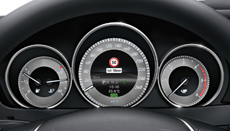
3-stage Electronic Stability Program ESP® [6] In critical situations, the 3-stage Electronic Stability Program (ESP®) can help to stabilise the vehicle by applying a braking force to individual wheels, and adjusting engine output. Three control strategies are available at the push of a button. With the ESP® switch the driver can simply select from "ESP® ON", "ESP® SPORT HANDLING MODE" and "ESP® OFF" modes. If ESP® is switched on and detects a critical dynamic situation, it applies the brakes systematically to one or more wheels in a targeted manner according to the situation. Should the system consider it necessary, it will also make an automatic adjustment to engine torque. In this way ESP® helps the driver to stabilise the vehicle (within the laws of physics) – particularly when cornering and during sudden evasive manoeuvres. - Central feature: The yaw-rate sensor continuously monitors vehicle movement around its vertical axis and compares the actual values measured with the optimum desired value based on the driver's steering input and the vehicle's speed. The instant the vehicle deviates from the ideal line, ESP® intervenes by working to counteract any swerving movements as they occur.
- The best possible traction: The integrated acceleration skid control (ASR) function additionally controls skidding by intervening in engine management in acceleration phases.
- Enhanced safety: As an integrated component of ESP®, ABS helps to prevent the wheels from locking when braking and to maintain steerability.
- Additional components: ESP® rounds off the functions of the anti-lock braking system (ABS) and acceleration skid control (ASR) to help with driving stability.
| |
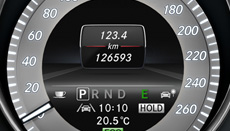
ADAPTIVE BRAKE with HOLD function and brake drying in wet conditions The standard-fit ADAPTIVE BRAKE system improves ride comfort and safety by helping to perform critical braking manoeuvres with the basic function of the ABS anti-lock braking system while convenience functions make it easier to master challenging driving situations. - Supporting HOLD function: Activating the HOLD function of the ADAPTIVE BRAKE system by firmly depressing the brake pedal prevents the vehicle from rolling unintentionally when stationary at traffic lights or in stop-and-go traffic. The driver can remove his foot from the brake pedal; this helps reduce stress for the driver
- Additional help: The Hill-Start Assist function prevents the vehicle from rolling back unexpectedly on inclines when moving from the brake to the accelerator pedal
- Full braking power without delay: The "brake drying" function removes the film of water that forms on the brake discs in wet conditions.
| |
Adaptive brake lights, flashing In critical braking situations, specific criteria such as brake pressure and road speed are used to activate the adaptive brake lights if necessary. When activated, the brake lights flash to give drivers behind even better warning of the risk of a rear-end collision. Studies have shown that drivers' brake-activation response times are shortened by up to 0.2 seconds when emergency braking is indicated by a flashing red warning signal instead of conventional brake lights. At a speed of 80 km/h, this reduction in response time corresponds to a reduction in stopping distance of approximately 4.40 metres. The brake lights flash with a frequency of approx. 3 Hertz (with incandescent bulbs) or approx. 5 Hertz (with LEDs); tests have shown this frequency to be particularly effective.
The adaptive brake lights are activated if the initial speed is greater than 50 km/h and Brake Assist BAS has recognised an emergency braking situation; or the driver applies the brakes with force. As soon as the vehicle comes to a standstill, the hazard warning signal is automatically activated if the initial speed was more than 70 km/h before braking was initiated. | |
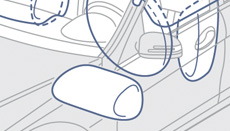
Airbags for driver and front passenger The airbags for the driver and front passenger provide protection for the occupants’ heads and upper torsos in a collision, and also afford additional stability to the entire body. They are thus able to mitigate the severity of injuries sustained in an accident. If the crash sensors detect an impending collision, the airbags are deployed. For this, a current impulse is sent from the control unit which ignites the kneebag’s initiator, which in turn ignites a solid propellant. The gases which are released in this way fill the airbag. The gases are subsequently expelled from the side of the airbag, away from the occupants.
The gas generators of both front airbags work in two stages. Both stages are activated depending on the braking force applied. Depending on the predicted severity of the impact, the first stage of the gas generator is initially activated and the airbag only partially filled (60% for driver and 70% for front passenger). If a higher severity of impact is predicted, the second stage of the gas generator is activated after a slight delay and the airbag is completely filled. 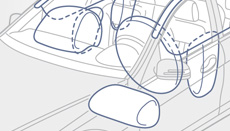
| |
Anti-lock braking system (ABS) The anti-lock braking system (ABS) enhances driving safety, especially when braking for hazards. During hard braking the anti-lock braking system reduces wheel lock-up by modulating the braking pressure of the individual wheels. This ensures that the vehicle remains directionally stable and steerable while maintaining maximum braking power. In other words: ABS allows the driver to brake and steer simultaneously – allowing precise evasive manoeuvring – in order to avoid an accident.
| |
BAS Brake Assist system with additional braking power if an emergency stop is detected Brake Assist can detect emergency braking situations based on the speed with which the brake pedal is depressed and assists the driver by increasing the brake pressure. The system interprets a certain speed at which the brake pedal is depressed as an emergency situation, and automatically builds up maximum braking power within fractions of a second. Brake Assist is integrated in the ESP® Electronic Stability Program and employs the latter's technology to control brake pressure so that no additional components are required. A sensor permanently monitors the speed at which the brake pedal is depressed and transmits this data to the electronic control unit.
If an unusually high pedal speed is registered, the system concludes that there is an emergency braking situation. The system then helps the driver to perform an emergency stop by automatically increasing brake pressure in the wheel brake cylinders. ABS continues to precisely meter the braking power up to the slip threshold, which ensures that steering control is maintained. If the driver reduces brake pedal pressure, automatic brake boosting is immediately deactivated. | |
Brake pad wear indicator warning lamp for front axle brakes | |
| |
ESP® Electronic Stability Program[3] In critical situations, the Electronic Stability Program (ESP®) can help to stabilise the vehicle by applying a braking force to individual wheels, and adjusting engine performance.
If the ESP® system detects a critical situation, it applies the brakes systematically to one or more wheels according to the situation. Should the system consider it necessary, it will also make an automatic adjustment to engine torque. In this way ESP® helps the driver to stabilise the vehicle within the laws of physics – particularly when cornering and during sudden evasive manoeuvres. - Central feature: the yaw-rate sensor continuously monitors vehicle movement around its vertical axis and compares actual values with the optimum value based on the driver’s steering movements and the vehicle’s speed. As soon as the vehicle deviates from the ideal line, ESP® intervenes by counteracting any swerving movements as soon as they occur
- Optimum traction at all times: integrated acceleration skid control (ASR) also controls skidding by intervening in engine management
- Enhanced safety: as an integrated component of ESP®, ABS helps to prevent the wheels from locking and to maintain their steering function
- Additional features: ESP® supplements the functions of the anti-lock braking system (ABS) and acceleration skid control (ASR) by providing a driving stability function
| |
The Headlamp Assist system reduces the strain on the driver by automatically switching on low-beam headlamps, tail lamps and number plate illumination in accordance with outside light conditions. The assistance system performs this task when it is raining or snowing by electronically detecting the cycles of the windscreen wipers. .
| |
Foot-activated parking brake | |
Fluid level warning indicator for fuel, oil, coolant and screen wash | |
Rear windscreen wiper with intermittent function, automatically activated when reversing | |
ISOFIX anchorage system in the rear and TopTether securing points on back of rear-seat backrest The ISOFIX child seat attachment system is a quick, convenient, non-vehicle-specific system conforming to ISO standards. It allows quick and easy child seat attachment in the rear. Its fixed anchorage points ensure a high degree of protection in the event of an accident. A special ISOFIX child seat engages in the attachment points housed in the lower area of the backrest. This creates a rigid connection with the vehicle structure, meaning that seat movements caused by slack or incorrectly fitted seat belts can be avoided. TopTether is an additional safeguard that is attached at a point behind the rear head restraints. It further reduces the risk of the child seat tilting forwards in the event of a crash.
| |
Childproof locks, manually operated on the rear doors, and power windows in the rear The childproof locks can be used to prevent the doors from being opened and the windows from being operated in the rear. The locks are set manually for the rear doors and electrically for the power windows.
| |
The kneebag on the driver’s side helps to protect the legs in the event of an impact and at the same time stabilises the entire body. It can thus help mitigate the potential severity of injuries sustained in an accident. If the crash sensors detect a collision of a certain severity, the kneebag is deployed. | |
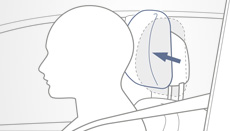
5 height and angle-adjustable head restraints for driver, front and rear passengers, NECK-PRO crash-responsive head restraints for driver and front passenger Activated in the event of a rear-end collision, NECK-PRO head restraints are adjustable for the driver and front passenger and can reduce the risk of sustaining a whiplash injury. If a collision occurs, they provide head support and reduce the load on the spine at an early stage by employing a spring mechanism to thrust the head restraints forward and upwards. After their deployment the head restraints can be manually returned to their original position. | |
Headlamp range adjustment The headlamp beam control adjusts the light cone of the headlamps to the pitch angle of the vehicle. As a result, the driver is always provided with optimum road illumination, without dazzling vehicles up ahead or oncoming traffic. | |
| |
Tyre pressure loss warning system The tyre pressure loss warning system helps to prevent accidents by alerting the driver to a dangerous drop in pressure in individual tyres. The system monitors the rotational speed of individual wheels and can identify significant losses in pressure according to speed changes. The warning is issued via a display in the instrument cluster. | |
Windscreen with rain sensor The electronically-controlled rain sensor detects automatically if the windscreen is wet and controls the wipe interval accordingly when the driver activates the intermittent wiper control function. | |
ASSYST service interval indicator The ASSYST service interval display computes the date of the next service based on driving style and shows it in the instrument cluster. | |
3-point seat belts with manual belt height adjustment, belt force limiters for the front seats and automatic belt height adjustment for the outer rear seats | |
Sidebags for driver and front passenger The sidebags fitted as standard for the driver and co-driver provide protection for the occupants' bodies in a side-on collision, and also afford additional stability to the entire body.They are thus able to reduce the severity of injuries sustained in an accident. | |
Seat occupancy sensor for front passenger seat | |
TIREFIT with tyre inflation compressor The TIREFIT tyre sealant enables the vehicle to continue driving after suffering a puncture, if this is a simple perforation. The sealant is pumped into the flat tyre using a tyre inflation compressor, seals holes in the tyre and allows the vehicle to continue on its way to the nearest workshop. | |
First aid kit in front-passenger door | |
| |
Electronic immobiliser including locking system with infrared remote control on electronic key in chrome look | |
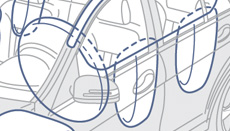
In the event of a sufficiently severe side impact, the windowbag deploys to cover the side windows and reduce the risk of a collision between the passenger’s head and the side of the vehicle or of objects penetrating the vehicle interior. The windowbag is triggered simultaneously with the standard-fit front sidebag and pelvisbags and always on the side of the vehicle facing the impact. When deployed, the windowbag covers the side panes between the A- and C-pillars like a curtain. The window airbag covers a large part of the side when deployed.
The window airbag provides the following advantages:
- Protection potential for the head in a side-on collision.
- Technical design and large volume provide excellent protection even for occupants of different physiques
- The deployment between A- and C-pillar also protects rear passengers in the outside seats.
- Reduces head movement in the event of a direct collision.
- Reduces the intrusion of splinters, shards and other objects.
| |
Central locking with interior switch, automatic locking (can be deactivated) and crash sensor with emergency opening The central locking system can be operated by means of an interior switch. The doors are locked automatically when the vehicle is in motion. In the event of an accident, all doors are unlocked by the crash sensor with the emergency opening function. The tailgate is locked automatically when the vehicle exceeds a speed of 3 km/h. The doors are additionally locked when the vehicle exceeds a speed of 15 km/h. The doors are unlocked when a door is opened or the interior switch for the central locking system is activated. If no doors or the tailgate are opened for 40 seconds after the vehicle has been unlocked via the electronic key, the vehicle will be locked again. | |