
Safety as a keynote
Safe driving
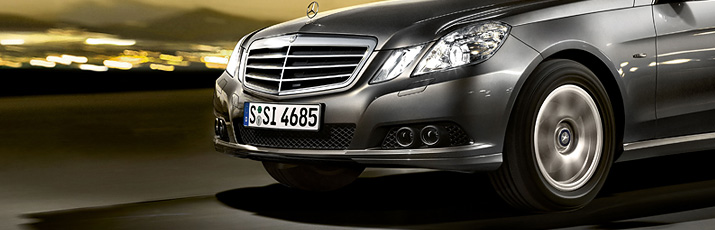
The Mercedes-Benz safety concept includes a range of measures based on safer driving. The control and display system, for example, helps to minimise distractions. Other systems can provide key information and support the driver in critical situations.
The adaptive brake lights warn vehicles behind that emergency braking is taking place. If the driver makes an emergency stop from a speed greater than 50 km/h, the brake lights flash in order to warn traffic behind. And if the vehicle comes to a stop from a speed greater than 70 km/h, the hazard warning lamps are switched on automatically. | |
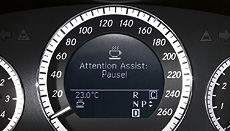
The standard-specification ATTENTION ASSIST can warn the driver and recommend taking a break as soon as it detects signs of driver drowsiness. The system monitors the driver’s behaviour in particular. If it deviates from a previously determined profile, visual and audible warnings are emitted.
| |
The ADAPTIVE BRAKE system improves ride comfort and safety by helping to execute critical braking manoeuvres with the basic function of the anti-lock braking system (ABS) and making difficult driving situations easier with convenience functions. These include the HOLD function, which is activated by briefly depressing the brake pedal when the vehicle is at a standstill. It keeps the vehicle from rolling unintentionally at traffic lights or in stop-and-go traffic. Hill-start assist prevents the vehicle from rolling back when pulling away on a slope both in forward and in reverse gears. It holds the vehicle briefly when you have removed your foot from the brake, allowing you time to change to the accelerator pedal. The "brake drying" function removes the water film which forms on the brake discs in wet conditions, thus ensuring that full braking pressure is available without the slightest delay. And with the "priming" function, the system swiftly moves the brake pads close to the discs immediately if the driver removes his foot from the accelerator suddenly. This reduces brake response time, which in turn shortens the stopping distance. | |
The electronic parking aid PARKTRONIC monitors the front and rear of the vehicle when manoeuvring with the help of ten sensors and warns the driver if it detects a risk of collision. If the system identifies an obstruction, it emits a visual signal. As soon as the distance is less than approx. 35 cm, a short warning sound is emitted. If the vehicle gets even closer (less than approx. 25 cm away) a continuous signal is heard. PARKTRONIC uses this procedure to make parking easier, even with limited space available. Parking Guidance helps the driver, not only when parking, but also when looking for a parking space. Because the ultrasonic sensors measure the length of parking spaces parallel to the car automatically at vehicle speeds of 30 km/h or less. If a suitable space is found, Parking Guidance then provides precise directions regarding the correct steering angle as well as the turn-in and turn-back points.
| |
The Driving Assistance package consists of DISTRONIC PLUS, BAS PLUS, PRE-SAFE® brake as well as the Lane Keeping Assist and Blind Spot Assist systems, and the automatic child-seat recognition sensor. At the touch of a button, the optional DISTRONIC PLUS proximity control system can help keep the vehicle at a preset distance from vehicles travelling ahead, operating in the speed range from 0 to 200 km/h. Radar sensors continuously measure the distance and speed relative to the vehicle ahead. The system can regulate the speed and, if necessary, intervene to brake the vehicle. The package also comprises the BAS PLUS braking assistance system, which can help reduce stopping distances in an emergency. The PRE-SAFE® brake complements the system with its automatic braking function, which applies the brakes automatically if the radar sensors detect the danger of a collision. Around 2.6 seconds before a possible rear-end collision it emits a visual and acoustic warning. And approx. 1.6 seconds before the impending impact it initiates a braking manoeuvre if the driver has not reacted to the warnings. Then about 0.6 seconds before what is considered an unavoidable impact, it causes an autonomous full brake application if the driver has not reacted. The Lane Keeping Assist feature registers lane markings and warns the driver using steering wheel vibrations if the vehicle unintentionally drifts out of the lane. The Blind Spot Assist system monitors the blind spot (to a distance of three metres) at the side of the vehicle. If the system detects a vehicle in the blind spot, the driver is alerted to the danger through an audible signal and a red triangle is displayed in the exterior mirror in question. | |
The Driving Assistance package consists of DISTRONIC PLUS, BAS PLUS, PRE-SAFE® brake as well as the Lane Keeping Assist and Blind Spot Assist systems, and the automatic child-seat recognition sensor. At the touch of a button, the optional DISTRONIC PLUS proximity control system can help keep the vehicle at a preset distance from vehicles travelling ahead, operating in the speed range from 0 to 200 km/h. Radar sensors continuously measure the distance and speed relative to the vehicle ahead. The system can regulate the speed and, if necessary, intervene to brake the vehicle. The package also comprises the BAS PLUS braking assistance system, which can help reduce stopping distances in an emergency. The PRE-SAFE® brake complements the system with its automatic braking function, which applies the brakes automatically if the radar sensors detect the danger of a collision. Around 2.6 seconds before a possible rear-end collision it emits a visual and acoustic warning. And approx. 1.6 seconds before the impending impact it initiates a braking manoeuvre if the driver has not reacted to the warnings. Then about 0.6 seconds before what is considered an unavoidable impact, it causes an autonomous full brake application if the driver has not reacted. The Lane Keeping Assist feature registers lane markings and warns the driver using steering wheel vibrations if the vehicle unintentionally drifts out of the lane. The Blind Spot Assist system monitors the blind spot (to a distance of three metres) at the side of the vehicle. If the system detects a vehicle in the blind spot, the driver is alerted to the danger through an audible signal and a red triangle is displayed in the exterior mirror in question.
| |
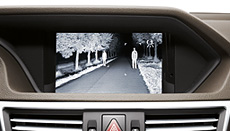
Night View Assist Plus helps the driver by reducing the risk of overlooking dangerous situations without switching to high beam and without dazzling oncoming traffic. The system works with infrared headlamps and an infrared camera. Monitoring the entire high-beam area, a grey-scale image is shown the central display of the COMAND APS multimedia system. This option makes it easier to identify people, animals and objects on the road even when visibility is poor. The integrated pedestrian detection function can also detect other pedestrians within the camera’s field of vision and highlight them in the display.
| |
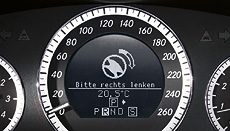
Lane Keeping Assist warns the driver by means of discreet steering wheel vibration as soon as he or she unintentionally drifts across lane markings registered by the system. If the turn indicator is operated or the steering wheel is turned with determination, the system assumes that the lane change is intentional and does not issue a warning. Blind Spot Assist warns the driver if it detects another vehicle in the critical area to the right or to the left of the vehicle.
| |
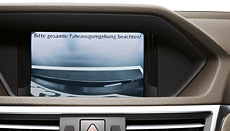
The camera integrated in the tailgate transmits an image of the area behind the vehicle to the COMAND central display. The rear-view camera not only makes parking easier but also enhances safety when reversing and manoeuvring on difficult terrain.
|
[1] Not available in all countries

