


The integral safety concept from Mercedes-Benz divides vehicle safety into four phases:
Virtually no other area inspires the Mercedes-Benz engineers to produce such consistently impressive results as much as research into new safety technologies. The first important safety milestone was reached back in the 1950s with the development of the passenger safety cell, invented by Béla Barényi. Today it is just one of many components of the integral safety concept which edges us ever closer to our vision of accident-free driving.
Phase 1: safe driving
The majority of accidents start long before the actual collision: with a lapse in concentration, poor visibility or hazards which cannot be anticipated. To promote safe driving, the Mercedes-Benz safety concept supports you with many features which promote relaxed motoring and help you to bring critical situations under control in your daily life.
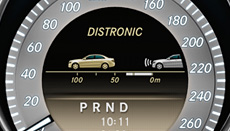
DISTRONIC PLUS adaptive cruise control can help the driver to maintain a specified distance from the vehicle in front at the push of a button when travelling at speeds of 0 to 200 km/h. To do this, radar sensors permanently monitor the distance and speed relative to the vehicle ahead and automatically adjust the vehicle’s speed. If a potential danger is identified, the system initiates controlled braking of the vehicle.
| |
| |
The Adaptive Highbeam Assist switches to low beam as soon as the camera detects another vehicle with its lights on, and regulates the low-beam range accordingly. It is no longer necessary to switch manually back and forth between the low-beam headlamps and main beams. The system completely utilises the optimum headlamp range of the low beams of up to 300 metres, making it easier to spot the course of the road, pedestrians or danger spots earlier. | |
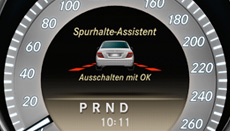
The Active Lane Keeping Assist feature warns the driver by means of a discreet vibration of the steering wheel as soon as he unintentionally drifts across the lane markings which have been registered by the system, and leaves the lane he is in. If the driver does not react, braking is applied to individual wheels as required. If, however, prior to crossing the lane, the indicator had been actuated or the steering wheel firmly turned, the system assumes that the lane change is intentional and does not react.
| |
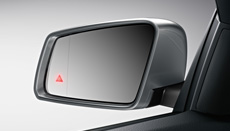
The Active Blind Spot Assist helps the driver to avoid dangers caused by other vehicles to the left and right of, as well as behind, the vehicle, when turning or changing lane. Close-proximity radar sensors monitor the difficult-to-see areas of the blind spot at speeds of between 30 km/h and 250 km/h. If the system detects another vehicle within monitoring range, a hazard warning triangle lights up in the corresponding exterior mirror. If the driver then operates the indicator, an additional audible warning is sounded. This also happens if vehicles move from two lanes away into the lane alongside the driver. If the driver does not react to the warning signal, the system can automatically brake the individual wheels in order to prevent a possible accident.
| |
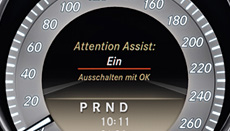
The ATTENTION ASSIST function is particularly helpful on long journeys and when driving at night; the system warns the driver if it detects signs of failing attention and increasing weariness. Between 80 and 180 km/h, ATTENTION ASSIST warns the driver visually and audibly as soon as it detects any signs of drowsiness or inattention. The background: sensors analyse driving behaviour and can detect any changes compared with the previously determined individual driver profile.
| |
The ADAPTIVE BRAKE system improves ride comfort and safety by helping to execute critical braking manoeuvres with the basic function of the anti-lock braking system (ABS) and making difficult driving situations easier with convenience functions. Hill-Start Assist with the HOLD function helps the driver to avoid rolling forwards or backwards when moving off on a slope. The vehicle is held up briefly once the driver has taken his foot off the brake. There is enough time to move the foot to the accelerator pedal and move off, and the vehicle is prevented from rolling immediately. | |
The Brake Assist system (BAS) can help to prevent accidents in the event of danger. Based on the speed with which the brake pedal is depressed, it can identify an emergency braking situation and then automatically build up full braking power. At the same time, the anti-lock braking system (ABS) applies braking power up to the slip threshold – and steering control is maintained. Automatic brake boosting is terminated as soon as the driver releases the brake pedal. | |
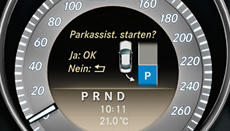
The PARKTRONIC parking aid including Parking guidance assists the driver when looking for a parking place and makes it easier to park by giving concrete steering instructions. Ultrasonic sensors in the side front bumper measure the length of parking spaces parallel to the car automatically if the car drives past at a speed of 35 km/h or less. Parking Guidance starts once a suitable space has been found and reverse gear has been engaged. It gives the driver visual and audible directions via the instrument cluster regarding the correct steering angle as well as the turn-in and turn-back points.
| |
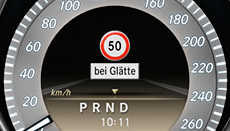
Speed Limit Assist uses an integrated camera to identify the speed limits on road signs and show the permitted maximum speed on the central display. The system also compares identified speed limits against the data stored in the navigation system.
| |
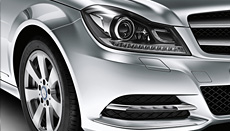
The Intelligent Light System emphasises the dynamic appearance of the C-Class Coupé through, amongst other attributes, its darkened headlamps and its dynamic design. But above all, it ensures better visibility and helps the driver to spot potential dangers early on. The system uses various technologies which, combined, give a high level of comfort and safety. In the country light mode the light from the low-beam headlamps is distributed such that the edge of the carriageway is significantly better illuminated than with conventional headlamps. The motorway mode is automatically activated in two steps: from 90 km/h the system boosts the power of the bi-xenon lamps. From 110 km/h the setting of the headlamp on the inside of the traffic lane also changes to illuminate the entire width of the lane uniformly for a distance of up to around 120 metres.
| |
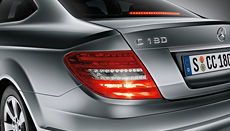
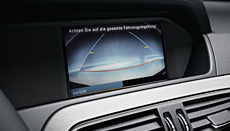
The reversing camera adds a convenient feature and also tangibly improves safety. The camera integrated in the tailgate transmits an image of the area behind the vehicle to the COMAND screen. The camera image not only makes parking easier but also aids in manoeuvring through hard-to-see terrain. The reversing camera is only available in conjunction with the optimum COMAND Online multimedia system.
|
Phase 2: in critical situations
Mercedes-Benz stands for automotive safety. That’s why our vehicles support their passengers even in critical driving situations, so that every drive is a good one, if at all possible.
When Mercedes-Benz first unveiled PRE-SAFE® in 2002, the primary aim was to combat the problem of the invaluable seconds often wasted just before an accident happens. The optional PRE-SAFE® safety system can make effective use of this time. Its sensors can detect critical driving situations, such as heavy oversteer/understeer, abrupt steering manoeuvres, panic braking and emergency stops. The PRE-SAFE® electronic system evaluates this information and can initiate preventive measures in typical critical situations to protect the vehicle occupants.
The PRE-SAFE® occupant protection system can recognise critical driving situations and, if necessary, pre-emptively activate reversible safety systems to help reduce the risk of injury to the vehicle occupants. To do this, PRE-SAFE® permanently monitors sensor data from systems such as the ESP® and BAS, and can thus, for example, recognise vehicle over/understeering as well as emergency braking. If the typical characteristics of a critical driving situation are identified, safety systems can respond within a fraction of a second. The electronic belt tensioners are activated, the electrically adjustable front-passenger seat (only in conjunction with Memory Package) is moved to a more "favourable" crash position, and the side windows and (optional) panoramic sliding sunroof are closed automatically. |
Phase 3: in an accident
Cars from Mercedes-Benz have a host of safety systems to prevent accidents. Should the worst come to the worst, however, a number of occupant safety measures are activated. They include protection for the vehicle occupants as well as for other road users.
The active bonnet can reduce the risk of injury to pedestrians and cyclists. If the system identifies a collision, the rear section of the active bonnet rises up by approximately five centimetres using spring force. This produces additional deformation space to absorb the impact energy. | |
The new C-Class Coupé is fitted with numerous airbags. In an accident, these can help to reduce considerably the risk of injury to passengers in the front and rear seats. The greatest possible protection is ensured by two-stage driver and front-passenger airbags, front sidebags and pelvisbags (rear sidebags are optional), driver kneebag, and windowbags extending across all seat rows. The windowbag protection zone covers virtually the entire area of the side windows. | |
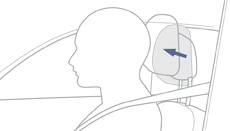
The sensor-controlled NECK-PRO head restraints for the front passengers can thrust the head restraint forward and upward in a matter of a few milliseconds, if an impact from the rear is detected. They can thus reduce the gap between the head and the restraint, thereby reducing the risk of injury.
|
Phase 4: after an accident
To reduce consequential damage after an accident and support the work of the rescue services, a number of different actions are initiated, depending on the type and severity of the accident:
- Maximum possible protection: The engine can be turned off automatically and the fuel supply can be cut off.
- Safe lighting: the hazard warning lights and emergency interior lights can be automatically activated, so as to reduce the risk of subsequent accidents and to make finding the vehicle easier.
- No need to break out: the side windows can be partially lowered and the door locking mechanism can be automatically released.
- Measure to aid rescue: integral crash joints between the wing and the door can make opening the doors after a frontal collision easier.
To complete its holistic safety philosophy, Mercedes-Benz has also published multilingual rescue guidelines (accessible worldwide on the internet) as a preventive measure for rescue services.
[1] Part of the optional Driving Assistance package Plus.
[2] Part of the optional Intelligent Light System.
[3] Part of the optional COMAND Online.

Fascination
Facts and figures
Advice and purchase
